24/7 Residential Service
Heater Repair Olathe KS
Residential heater, furnace and heating system repair for Olathe, Kansas homeowners — available 24 hours a day. We troubleshoot no-heat calls, furnaces blowing cold air, ignition faults, short cycling and airflow problems, then explain exactly what we found before any repair.
For service availability, please have your 5-digit ZIP code ready.
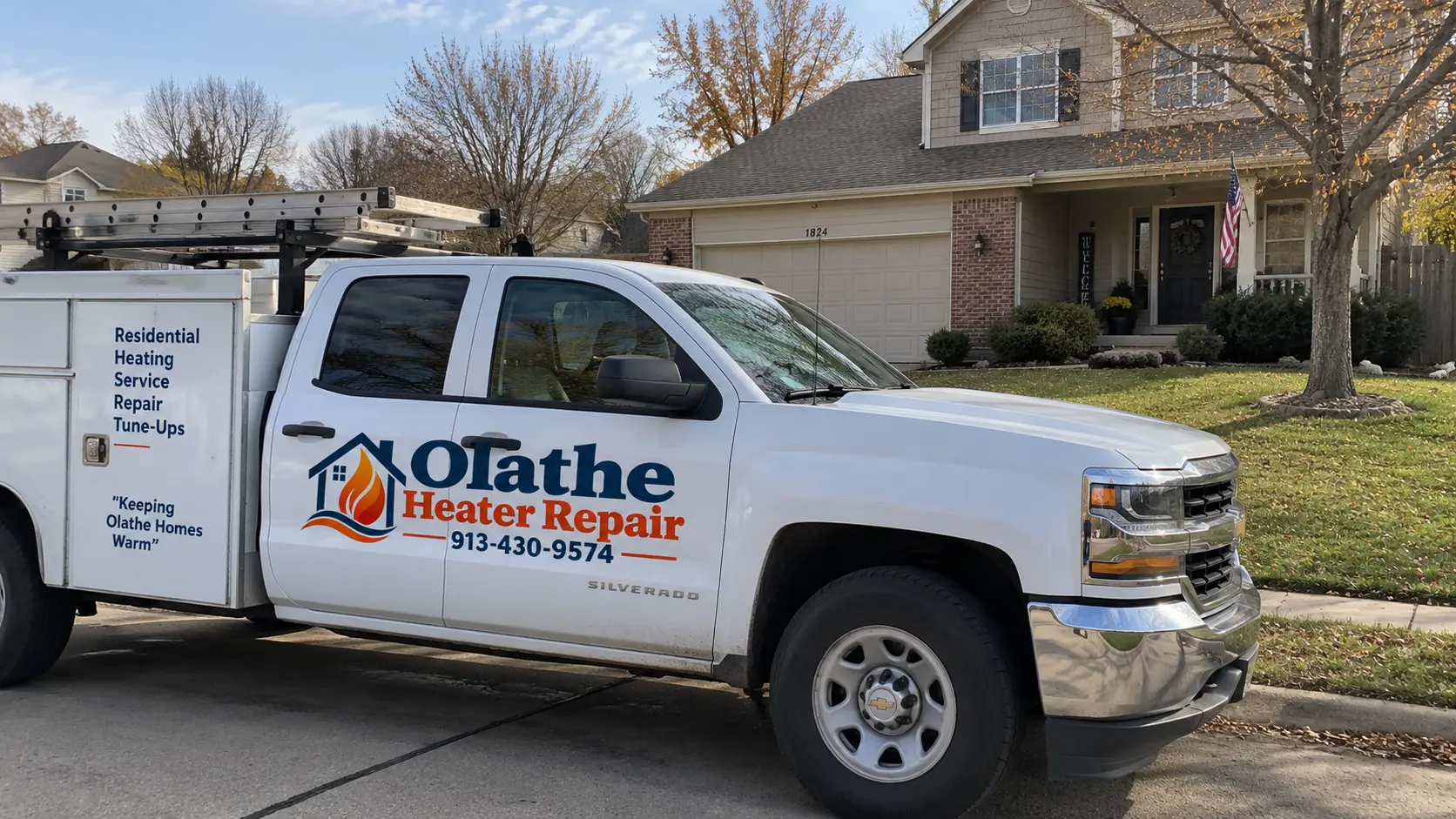
Residential heating service
Heater Repair in Olathe, Kansas
When a furnace quits in the middle of a Kansas cold snap, the first job is figuring out which part of the heating sequence stopped working. A furnace has to get a call for heat, prove airflow, ignite safely, keep the flame lit and move warm air through the ducts. A failure anywhere in that chain shows up as one of a handful of very recognizable symptoms.
These are the residential heating symptoms we are called about most often in Olathe:
- No heat at all — the system is completely unresponsive, or it runs without producing warmth.
- Furnace blowing cold air — the blower runs but the burners are not staying lit.
- Furnace won't start — no response at the thermostat, or the furnace hums without igniting.
- Heater starts then stops — the burners light, run briefly, then shut down.
- Weak airflow — little air at the registers even when the furnace sounds like it is running.
- Short cycling — repeated brief heating cycles that never satisfy the thermostat.
- Unusual furnace noises — banging, rattling, squealing, grinding or a rumble at startup.
- Burning or unusual smells — anything beyond the brief dust smell at the first heat of the season.
- Thermostat not responding — a blank display, unresponsive buttons or a system that ignores setpoints.
- Ignition problems — a cracked igniter, dirty flame sensor or lockout after repeated attempts.
- Pilot problems — on older systems, a pilot that will not stay lit.
- Blower issues — a blower that will not start, runs constantly or makes a bearing noise.
Each of those symptoms has a short list of likely causes, which is why diagnosis comes first. Guessing at parts is how homeowners end up paying for components that were never the problem. If you want the deeper walkthrough for a specific system, start with gas furnace repair, electric heater repair or heat pump repair.
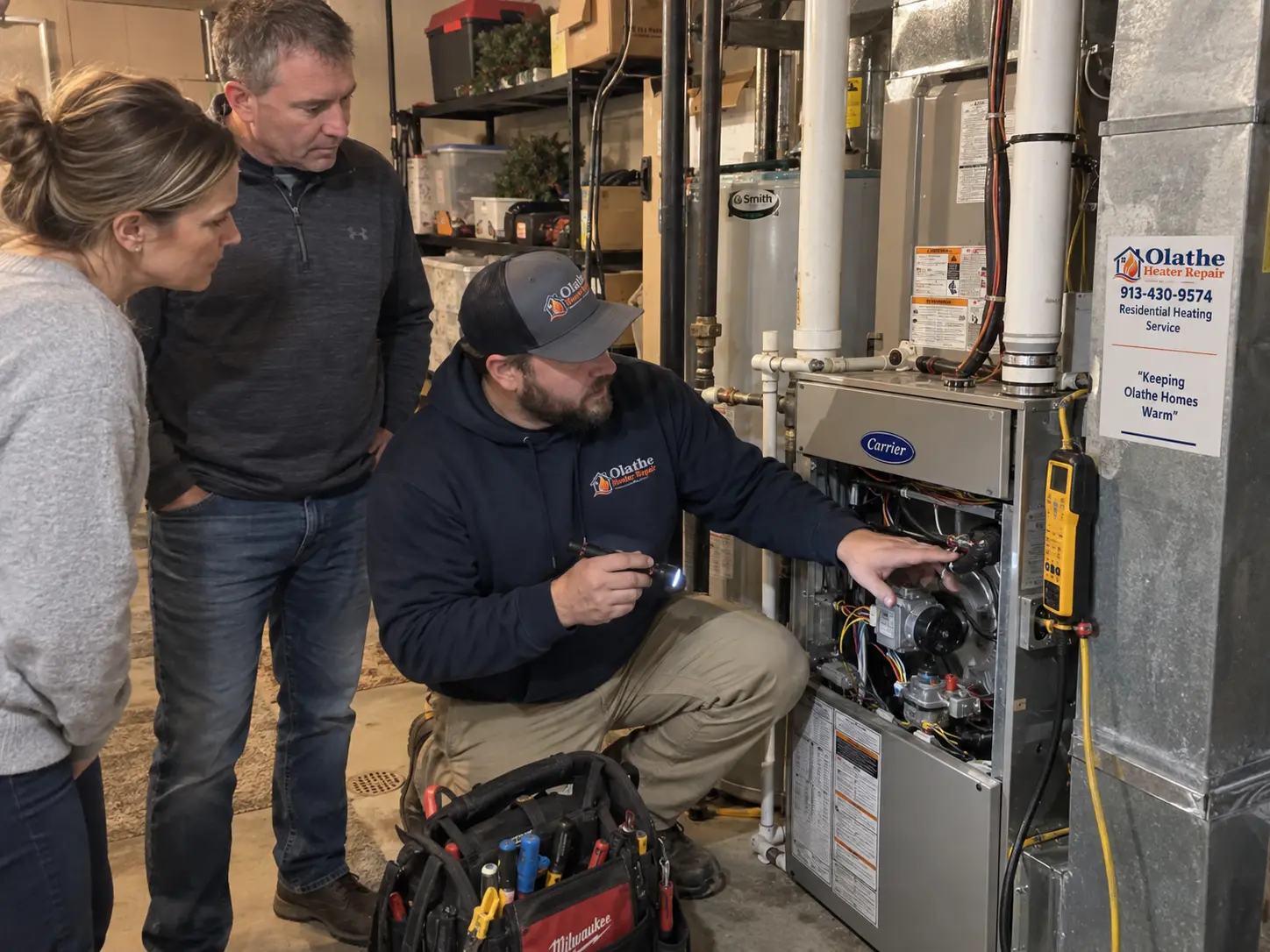
Not sure which symptom fits?
Describe what the system is doing and we will work through it with you on the phone. Have your 5-digit ZIP code ready so we can confirm service availability.
Call Now for FREE Quote913-430-9574Emergency triage
No Heat? Start Here
Still no heat?
Anything past this list involves gas, electrical or burner components. Call instead.
Call Now for FREE Quote913-430-9574For service availability, please have your 5-digit ZIP code ready.
Safety first
If you smell gas
Leave the home right away. Do not flip light switches, unplug anything, use a phone inside, light a match or try to restart the furnace. From a safe location away from the house, contact your gas utility or emergency services. Do not return until they say it is safe.
If a carbon monoxide alarm sounds
Get everyone, including pets, out of the home and call emergency services from outside. Do not go back in to open windows or investigate. CO is odorless, so treat an activated alarm as real every time.
Never attempt repairs involving gas lines, gas valves, burners, heat exchangers, or furnace wiring. Those components are the reason licensed service exists, and mistakes there are dangerous rather than merely expensive.
Diagnostics
Common Furnace Problems
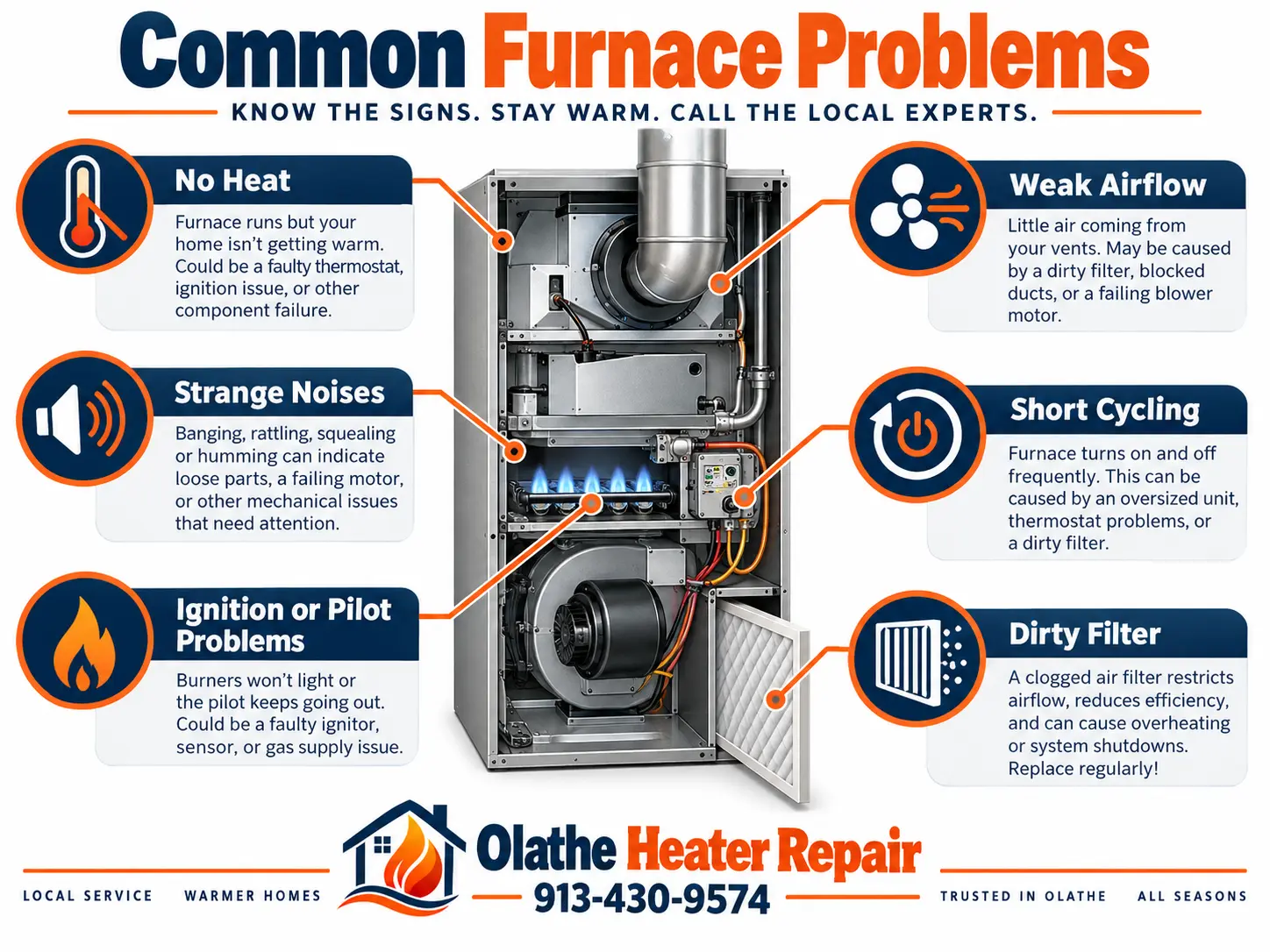
Hot surface igniters
The igniter heats until it glows, lighting the burners. They are brittle and fail with age or cracking, which produces a furnace that tries, clicks and gives up.
Flame sensors
A thin metal rod that proves flame is present. Oxidation on the rod makes the board think the flame failed, so the gas shuts off seconds after lighting — the classic cold-air complaint.
Thermostats
Dead batteries, wiring faults, a miswired C-wire after a smart thermostat swap, or placement near a supply register all cause strange behavior that looks like a furnace fault.
Blower motors
Moves heated air into the ducts. Failing bearings squeal, capacitors fail, and a dead blower means heat builds up inside the cabinet until the limit trips.
Inducer motors
Pulls combustion gases out through the flue before ignition. If it fails or runs weak, the pressure switch never closes and the furnace never lights.
Control boards
Runs the ignition sequence and safety logic. Failures are less common than parts stores suggest, which is why the board is confirmed, not assumed.
Limit switches
Shuts the burners down when cabinet temperature climbs too high. A tripping limit is almost always an airflow problem underneath, not a bad switch.
Pressure switches
Confirms the inducer is drawing properly. Blocked condensate drains, cracked hoses and obstructed flue terminations all cause pressure switch lockouts.
Gas valves
Meters gas to the burners. Genuine gas valve failures happen, but they are verified with testing — never swapped on a hunch.
Airflow and filters
A restricted filter or closed ductwork causes overheating, short cycling, cold rooms and premature component wear all at once.
Want the homeowner version?
Our guides walk through cold air from the vents and short cycling in plain language.
Equipment
Furnace Brands in Olathe Homes
Carrier
Widely installed across Olathe. Shares a platform with Bryant, so parts and diagnostics overlap.
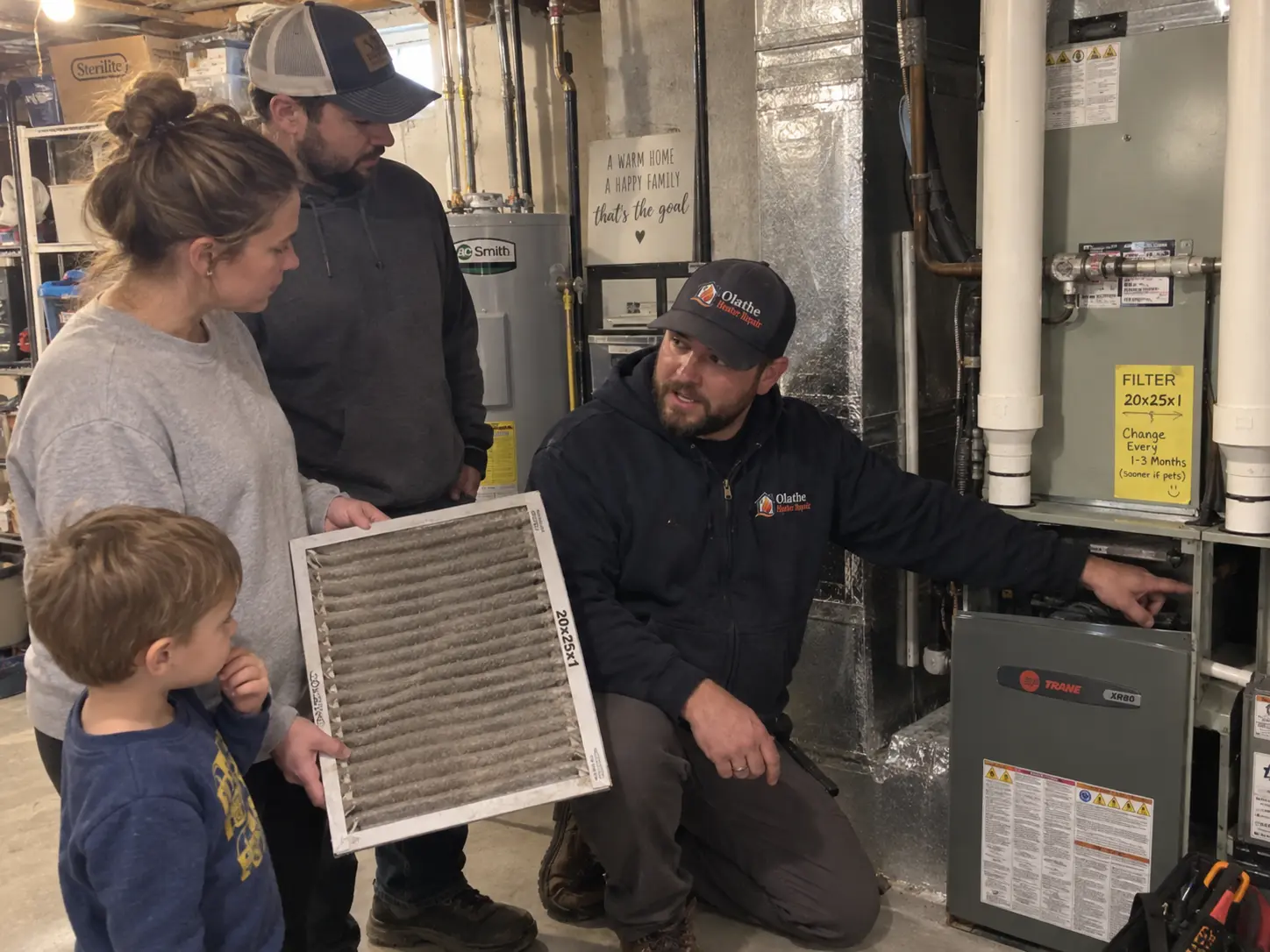
Trane
Frequently found in newer subdivisions, alongside American Standard equivalents.
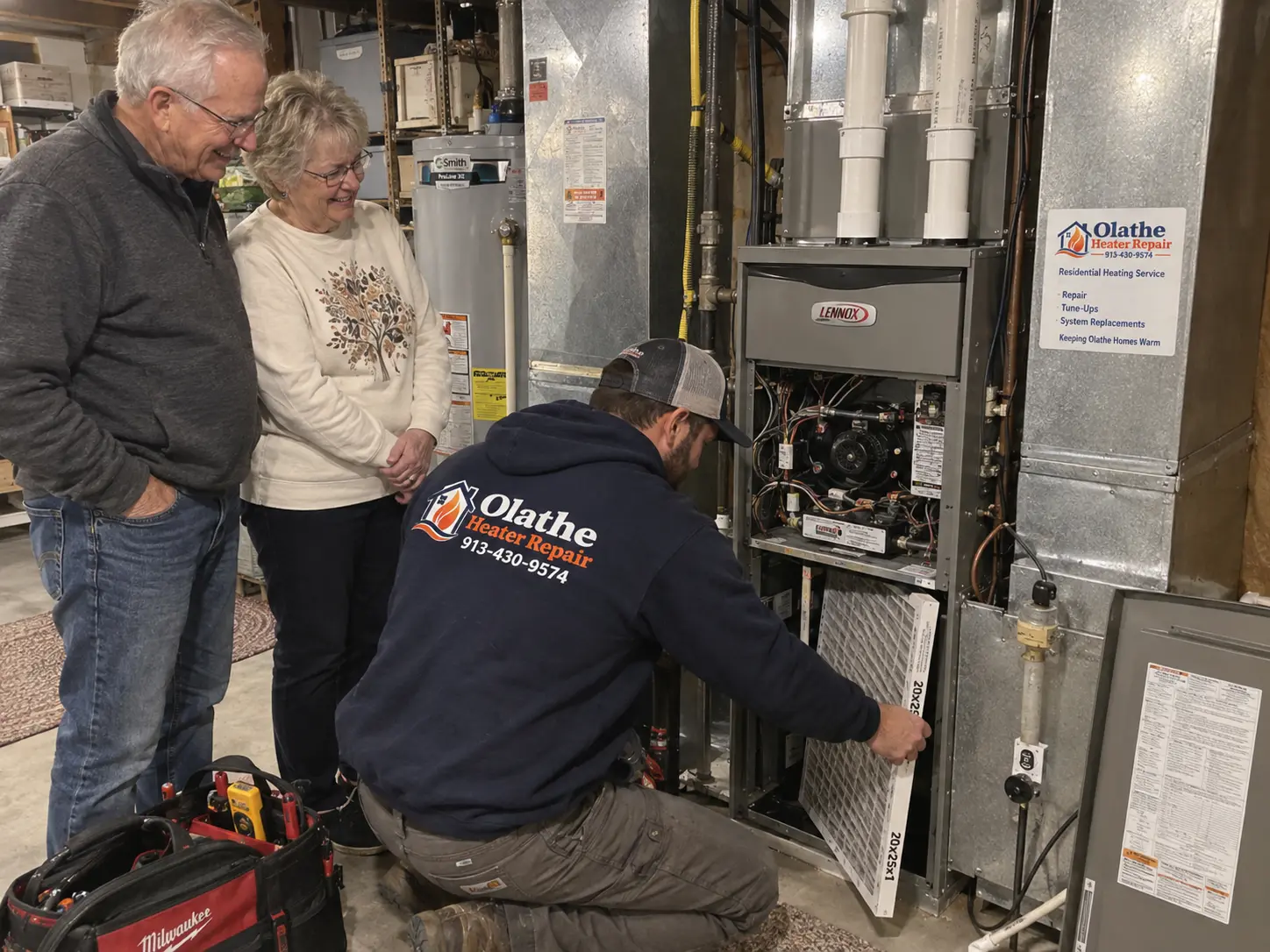
Lennox
Common in mid-2000s builds. Some Lennox parts are brand-specific rather than universal.
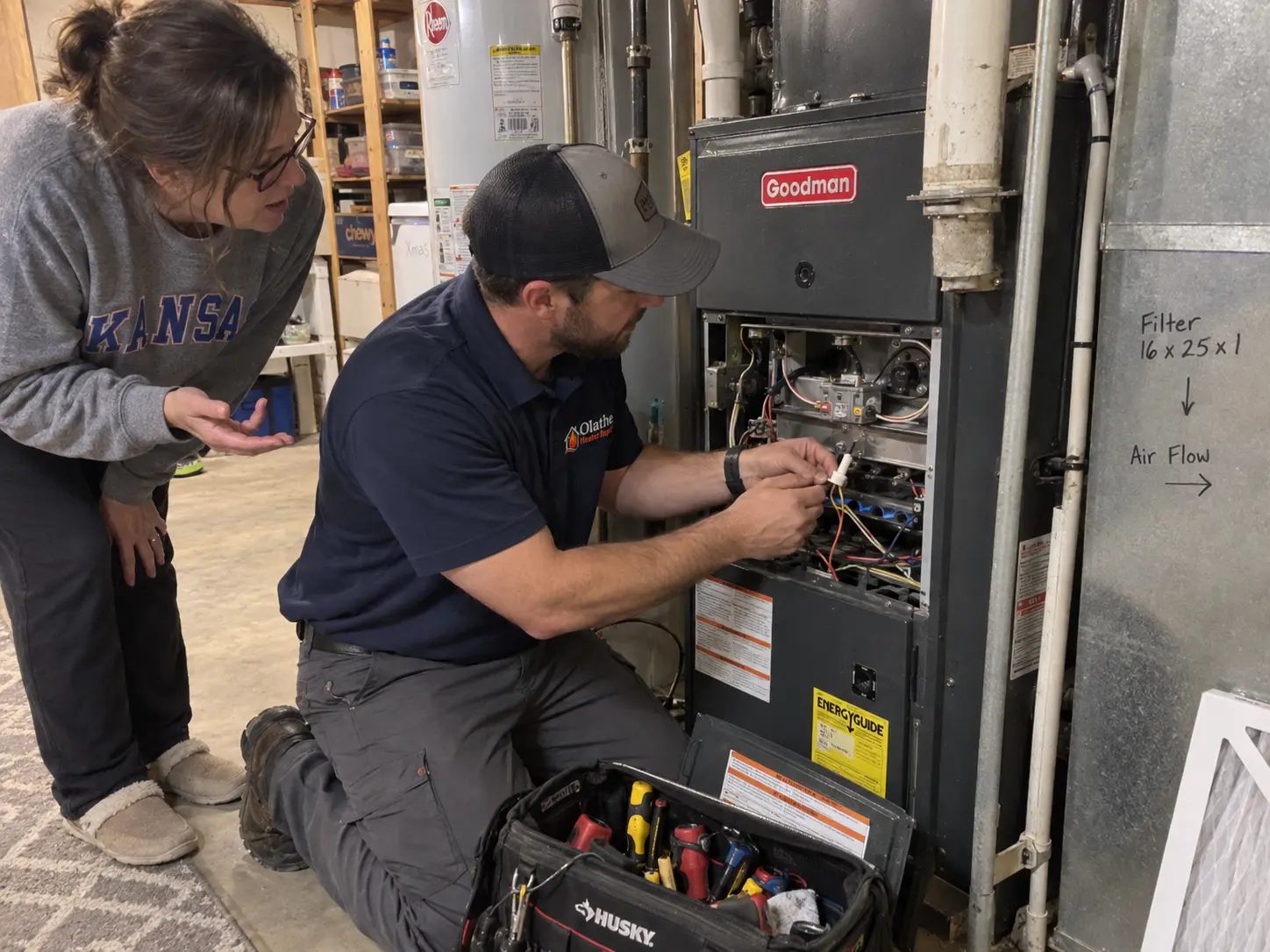
Goodman
Popular as a value replacement system. Parts are generally available and serviceable.
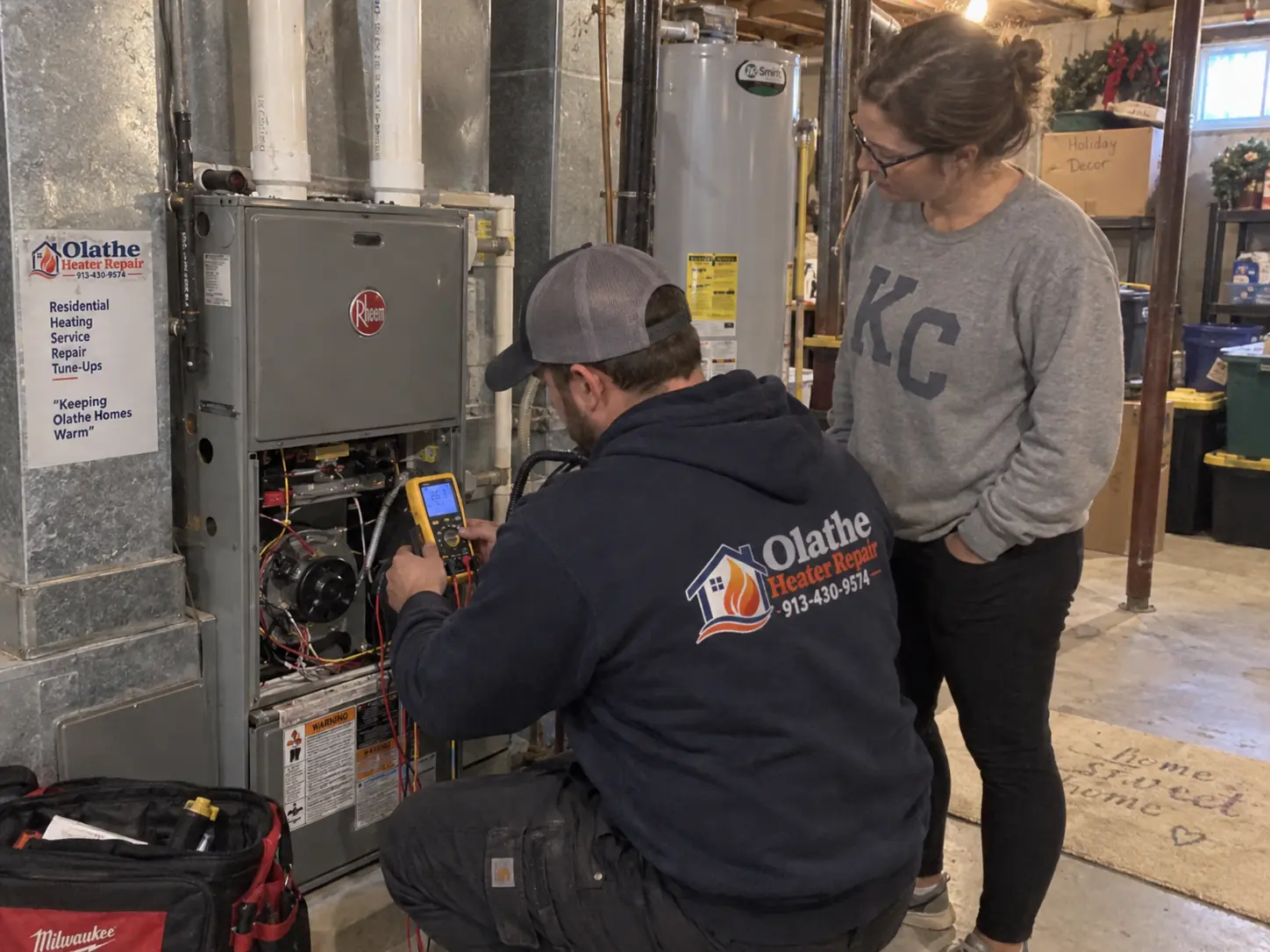
Rheem
Seen in both original and replacement installs, often paired with Rheem water heaters.
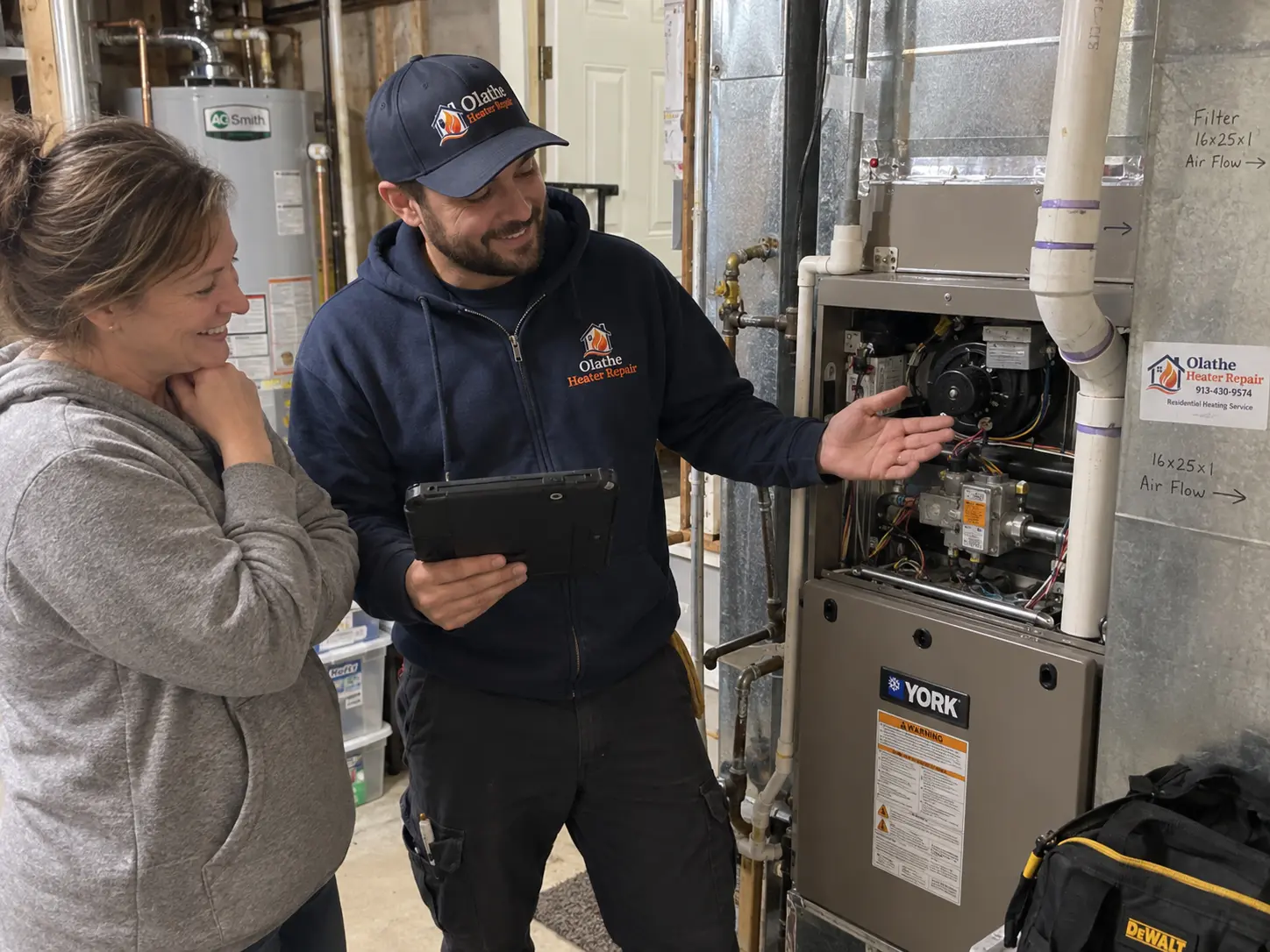
York
Regularly encountered in Johnson County homes, with familiar ignition and control layouts.
Bryant, American Standard, Amana, Payne and Ruud systems come up regularly too. If you are unsure what you have, the brand is usually printed on the front of the furnace cabinet or on the rating plate inside the door.
Our process
What Happens During a Heater Repair Visit?
- 01
Confirm symptoms
We start with what you observed: when it began, what the system does, whether it is intermittent, and any error codes you noted.
- 02
Inspect thermostat and airflow
Thermostat settings, wiring and call-for-heat signal, then filter condition, returns and register airflow. A surprising number of faults end here.
- 03
Test safety and operating components
Igniter, flame sensor, pressure switch, limit switch, inducer, blower, capacitor and control board signals are checked against how the system should sequence.
- 04
Identify the likely failure
We isolate the component or condition causing the fault rather than replacing parts hoping one lands.
- 05
Explain findings and options
You get a plain-language explanation of what failed, what the repair involves, what it costs, and whether the age of the system changes the recommendation.
- 06
Test operation after the work
The system runs through a full heating cycle to verify ignition, flame stability, airflow and shutdown before we leave.
Many repairs are completed on the first visit, but not all of them. Parts availability varies by brand, model year and how specialized the component is — a control board for an older or discontinued furnace may need to be ordered. If that happens, we tell you up front rather than leaving you guessing.
Planning your budget
Heater Repair Cost in Olathe
Heater Repair Cost Estimator — Olathe, KS
Planning ranges for common residential heating repairs. Not a quote.
Choose your system, symptom, age and timing to see a planning range.
Why heater repair costs vary
- Which component failed — a flame sensor cleaning and a blower motor replacement are not in the same universe.
- Furnace type — gas, electric and heat pump systems have different parts and different labor.
- Furnace age — older and discontinued models can require ordered or substituted parts.
- Accessibility — a furnace in an open basement is faster to work on than one wedged into a tight attic or closet.
- Diagnostic time — intermittent faults take longer to reproduce and confirm than hard failures.
- Parts — OEM-specific components cost more than universal ones.
- After-hours urgency — overnight and holiday calls during a hard freeze carry different labor rates than a scheduled daytime appointment.
We do not publish guaranteed pricing, because a guaranteed price before diagnosis is either padded or about to change. See the full cost page for more detail, or call 913-430-9574 for a free quote.
Honest advice
Repair or Replace?
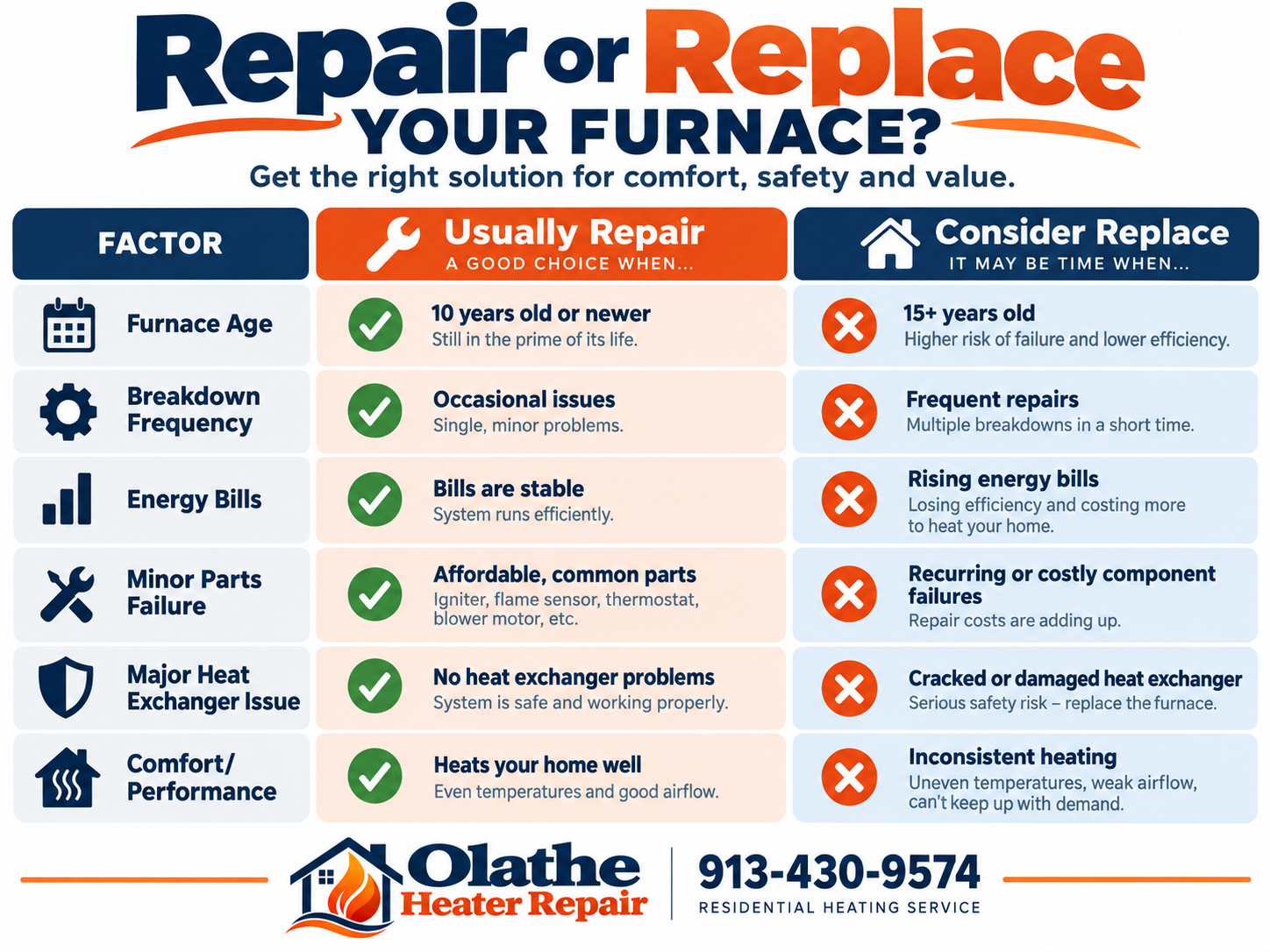
Most heating calls end in a repair, and that is usually the right answer. A furnace that is reasonably young, has a clean service history and failed at one normal wear component is worth fixing — often for a fraction of replacement cost.
Replacement becomes genuinely worth discussing when:
- The same system has had repeated major failures in a short span.
- A safety concern is found, particularly a cracked or damaged heat exchanger, which is a replace-the-furnace finding rather than a patch.
- A single repair is expensive relative to the remaining life of an aging system.
- Repair costs have been climbing year over year on equipment past 15-20 years.
We will tell you when a repair is the better value, including when that means we do less work. If you want to think it through before anyone is standing in your basement, read furnace repair vs. replacement for Olathe homeowners.
Local context
Heating a Home in Olathe, Kansas
Olathe sits in the middle of Johnson County, and its heating season is long enough that equipment gets real use. Winter temperatures routinely drop below freezing, cold snaps arrive fast, and swings of thirty degrees inside a single week are normal here. That pattern is hard on furnaces: a system that coasted through a mild December will often fail on the first genuinely cold night, when it has to run for hours instead of minutes.
The housing mix matters too. Older homes near Downtown Olathe and along the Santa Fe Street corridor often have furnaces in tight basements or utility closets, with ductwork that has been modified over the years. Newer construction west toward K-7 and Parker Street, and the subdivisions that fill in along I-35, tends toward high- efficiency condensing furnaces with PVC venting and condensate drains — which brings its own failure mode, because a frozen or clogged condensate line will lock out a furnace that is otherwise perfectly healthy.
Practically, that means two things for Olathe homeowners. First, the pre-season check matters: running the heat for a cycle in early fall surfaces problems while you still have the option of a scheduled appointment instead of an emergency one. Second, during an extended cold stretch, a furnace that is already marginal will show it. A system short cycling in November is usually a system that fails in January.
We serve homeowners throughout Olathe and the surrounding Johnson County communities — Lenexa, Overland Park, Gardner, Spring Hill and others nearby.
What you get
Why Homeowners Call Olathe Heater Repair
Explore
Residential Heating Services
Nearby Service Areas
Related searches
People Also Search For
Residential heater repair Olathe KS
This is the whole of what we do. Residential heating systems differ from commercial equipment in scale, controls and access: a home furnace is a single-stage or two-stage unit in a basement, attic, closet or crawlspace, sized for one household's ductwork. That focus matters in practice because the failure patterns repeat — igniters, flame sensors, pressure switches, limit switches, blower motors and thermostats account for the large majority of residential no-heat calls. We do not take commercial HVAC work, so a residential call is never competing with a rooftop unit across town.
Home heater repair Olathe KS
Homeowners searching this phrase usually want to know two things: can someone come out, and will they be straightforward about the cost. Bring your 5-digit ZIP code and a description of the symptom when you call, and you will get a realistic answer about availability instead of a vague window. On site, the process is diagnosis first, then an explanation of the failure and the repair options before work starts. If your system is old enough that a repair is a judgment call, we say so rather than quietly performing an expensive fix on equipment nearing the end of its life.
Electric heater repair Olathe KS
Not every Olathe home heats with gas. Electric furnaces and air handlers with heat strips are common in condos, townhomes, additions and homes without a gas connection. They fail differently: heating elements burn out, sequencers stop staging elements in order, contactors pit, high-limit switches trip and transformers fail. Symptoms include lukewarm air, a heater that trips its breaker, or heat that only works at certain settings. Electric heating circuits carry substantial current, so element and sequencer work is not homeowner territory. Our electric heater repair page covers the details.
Best heater repair Olathe KS
We are not going to tell you we are objectively the best — that claim means nothing without your specific situation. What you can compare is concrete: availability when you actually need service, whether they diagnose before quoting parts, whether pricing is explained in plain terms before work begins, whether they have real experience with your type and age of system, how clearly they communicate what they found, and whether they will honestly discuss repair versus replacement instead of defaulting to the bigger ticket. Ask those questions of anyone you call, including us.
Olathe HVAC
HVAC is the broad term covering heating, ventilation and air conditioning. Many companies serving Olathe cover all of it, plus plumbing or electrical in some cases. We deliberately don't: this is a residential heating service, focused on heaters, furnaces and home heating systems. If your search is about cooling, a full-service HVAC contractor is the right call. If it is about a furnace that won't heat on a cold Kansas night, a focused heating service is usually the faster route to a correct diagnosis.
Homeowner guides
From the Blog
Why Is My Furnace Blowing Cold Air in Olathe, KS?
A furnace that runs but pushes cold air is one of the most common winter calls in Olathe. Here's what it usually means.
Read guide →Furnace Won't Turn On? An Olathe Homeowner Checklist
Before you call, there are seven safe checks that solve a surprising number of dead-furnace calls.
Read guide →How Often Should Olathe Homeowners Change a Furnace Filter?
Filter thickness, pets and Kansas dust all change the answer. Here's a practical schedule.
Read guide →Furnace Repair vs. Replacement: What Olathe Homeowners Should Consider
Age alone doesn't decide it. Here are the factors that actually move the decision.
Read guide →Why Does My Furnace Keep Turning On and Off?
Short bursts of heat every few minutes are a symptom, not a setting. Here's what drives it.
Read guide →Heater Repair FAQs — Olathe, KS
How quickly can you respond to a heater problem in Olathe?
Do you provide 24/7 heater repair?
Why is my furnace running but not heating?
Why does my heater keep turning on and off?
Why is my furnace blowing cold air?
Can a dirty filter stop a furnace from heating?
Why won't my furnace ignite?
What causes weak airflow from my vents?
Should I repair or replace an older furnace?
What should I do if I smell gas?
What furnace brands are commonly found in Olathe homes?
How much does heater repair cost?
Can an electric furnace be repaired?
Should I turn off my heater if it is making unusual noises?
How often should I change my furnace filter?
What information should I have ready when I call?
Do you charge for a quote?
Residential Heater Repair Across Olathe
Olathe Heater Repair is a service-area business — we travel to your home rather than operating a customer-facing storefront. Call 913-430-9574 to confirm availability for your address.
No heat? Help is available 24/7.
Call now for a FREE quote and service availability.
Please have your 5-digit ZIP code ready.